


Wu Xiaoqiu: September 24 of 2024 represents an important historical milestone in the development of China's capital market
The following is a summary of Wu Xiaoqiu's remarks at the 51st Tsinghua University Forum on China and the World Economy held at Tsinghua University, Beijing, and broadcasted online on July 7, 2026. Wu is Director and National First-Class Professor at the National Academy of Financial Research (NAFR) at Renmin University of China.
On July 7, 2026, the 51st Tsinghua University Forum of China and the World Economy, hosted by Tsinghua University's Academic Center for Chinese Economic Practice and Thinking (ACCEPT) in partnership with the university's School of Social Sciences, was broadcasted online under the theme of China's 2026 Mid-Year Economic Update. Director and National First-Class Professor at the National Academy of Financial Research (NAFR) at Renmin University of China, Wu Xiaoqiu, delivered remarks and participated in roundtable discussions at the forum alongside other distinguished guests where he commented on the state of the Chinese economy.
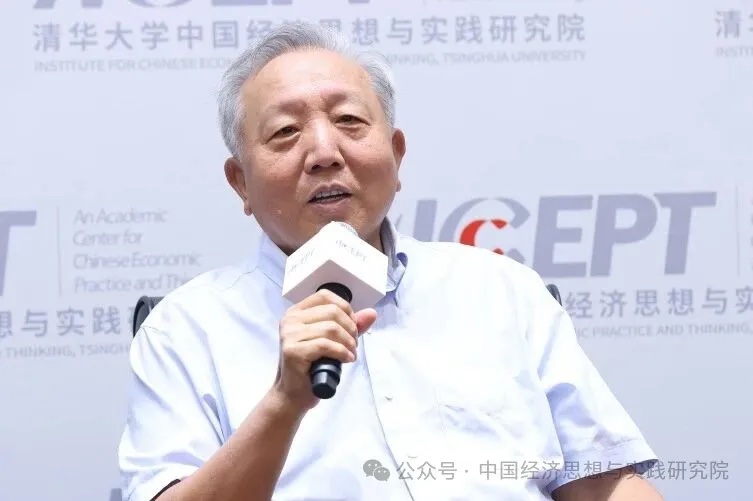
In the roundtable discussion segment on topics concerned with capital markets, Wu Xiaoqiu relayed that September 24, 2024, represents an important historical milestone in the development of China's capital market. The major change was not the rise or fall of the index, but rather a fundamental shift in the broader society's understanding of the functions of the capital market. He pointed out that the capital market is by no means just a financing platform; it is also a market for wealth management, a platform for incentivizing technological innovation, and a core hub for driving economic restructuring and industrial upgrading. Innovators and explorers at society's vanguard bear enormous risks, and society should reward them with institutionalized premiums accordingly. With this common understanding now established, reforms on the asset, capital and institutional sides have continued to advance side by side. The capital market ecosystem is now undergoing a systematic restructuring, and after the optimization of Article 5 in the STAR Market, high-tech enterprises are gradually becoming listing entities, while restrictions on access to long-term capital have been relaxed to a large degree. Meanwhile, the central bank has introduced innovative structural tools such as swaps and re-lending to provide liquidity support for the market. Legal measures have also been continuously strengthened, with penalties for violations rising from hundreds of thousands to hundreds of millions Chinese yuan or even leading directly to criminal penalties. Regarding market operations, he insisted that there will be no more systemic crashes triggered by institutional flaws like in 2015, although normal volatility and risks will always exist.