


Liu Peilin: Demographic aging is not the challenge it appears since the overall population is becoming more youthful over time
The following is a summary of Liu Peilin's remarks at the 51st Tsinghua University Forum on China and the World Economy held at Tsinghua University, Beijing, and broadcasted online on July 7, 2026. Liu is Chief Researcher at Tsinghua University's Academic Center for Chinese Economic Practice and Thinking (ACCEPT).
On July 7, 2026, the 51st Tsinghua University Forum of China and the World Economy, hosted by Tsinghua University's Academic Center for Chinese Economic Practice and Thinking (ACCEPT) in partnership with the university's School of Social Sciences, was broadcasted online under the theme of China's 2026 Mid-Year Economic Update. Chief Researcher at Tsinghua University's ACCEPT, Liu Peilin, delivered remarks and participated in roundtable discussions at the forum alongside other distinguished guests where he commented on the state of the Chinese economy.
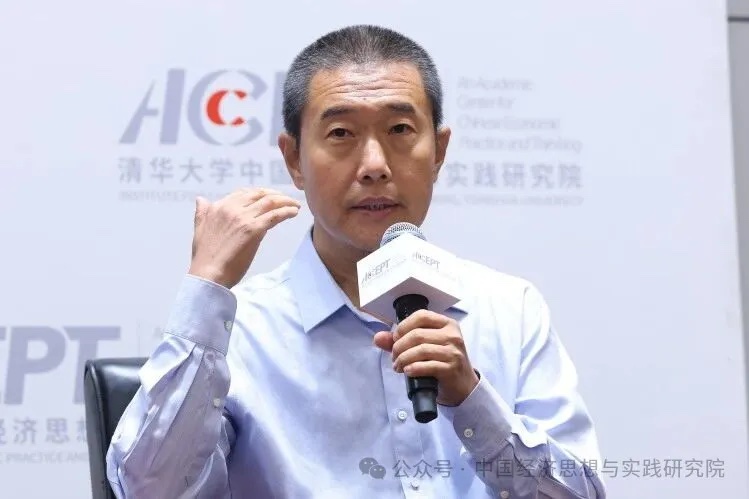
On commencement of the forum, Liu Peilin first presented the main findings from the 107th China Macroeconomic Analysis and Forecast Report on behalf of ACCEPT's research team. The core standpoint of the report emphasizes the need to continually bolster confidence, square off against any challenges head-on, identify major pain points and take well-targeted corrective actions accordingly. Liu pointed out that although economic indicators started to improve for a short while during the first quarter, this performance weakened in the second quarter. Even so, China's long-term economic growth potential remains considerable. He also took special care to disentangle claims that demographic aging would constitute a hinderance to the country's long-run economic development prospects. Applying the 65-year-old threshold for defining the elderly age group as established 70 years ago is no longer an appropriate standard in view of today's population structure. Based on contemporary health outcomes and life expectancy rates, the overall population could actually be described as trending younger, which therefore entails that the longer-term capacity for continued economic expansion remains ample.
Liu stated that among the three leading economic forces, China currently faces relatively weak investment and consumption, with growth mainly being driven by exports. Last year, China set a record for a single-country goods trade surplus exceeding one trillion US dollars. To some extent, external demand has played a role in offsetting sluggish domestic demand and has become an important driving force supporting China's economic growth. However, it should be noted that the resumption of the China-US trade war is still possible, and European countries led by Germany are also showing signs of engaging in trade disputes, such that China's export situation will remain highly uncertain moving forward into the future. Under the current circumstances, the compensatory effect that external demand is having on domestic demand cannot be sustained over the long term. In the looking ahead, efforts must continue to focus on stimulating domestic demand through increases in household income and making improvements to income distribution. This is a long-term goal that requires the joint efforts of multiple policies, and relevant measures should be introduced as soon as possible to avoid repeated delays that could deepen current challenges.