


Wei Shaojun: Architectural innovations in computing and software design to make up for gaps in integrated circuit manufacturing
The following is a summary of Wei Shaojun's remarks at the 50th Tsinghua University Forum on China and the World Economy held at Tsinghua University, Beijing, and broadcasted online on January 13, 2026. Wei is a Professor at Tsinghua University's School of Integrated Circuits.
On January 13, 2026, the 50th Tsinghua University Forum of China and the World Economy, hosted by Tsinghua University's Academic Center for Chinese Economic Practice and Thinking (ACCEPT) in partnership with the university's School of Social Sciences, was broadcasted online under the theme of "China's Economy in 2026." Professor at Tsinghua University’s School of Integrated Circuits, Wei Shaojun, delivered remarks and participated in roundtable discussions at the forum alongside other distinguished guests where he commented on the state of the Chinese economy.
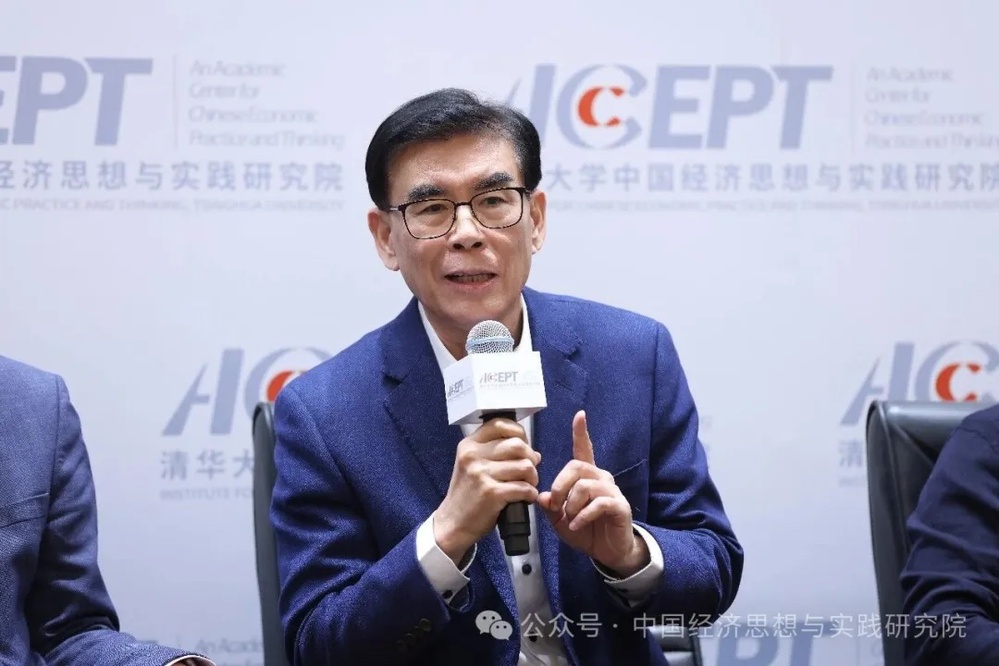
Wei Shaojun claimed that China's integrated circuit industry is approaching a critical stage of striding towards self-reliance and self-improvement, although all the bottlenecks have not yet been completely resolved. Even so, the country has already basically achieved independence in low- and mid-range chips as well as some high-end segments, while external blockades have only accelerated the restructuring of the domestic supply chain and market acceptance of domestic chips. In view of the objective weak points in manufacturing processes, Wei proposed a strategic pathway based on architectural innovations so as to make up for the shortcomings in these processes, asserting that in the context of the slowdown in Moore's Law, the same level of performance can be achieved without relying on the most advanced processes by instead optimizing the computing architecture and software design. However, he was also frank in his assessment that smartphone chips, given the particularly high requirements placed on their power consumption and volume, are at present the only area where it is difficult to completely compensate for gaps in manufacturing processes by simply introducing architectural innovations.
In response to arguments related to lane changing and overtaking in the integrated circuit industry, Wei was explicit in stating that new technologies such as photonic computing and quantum computing are unlikely to replace silicon-based semiconductors at the industrial level during the next two decades, with silicon-based technology holding onto its mainstream position as China continues to strive towards catching up within the most immediate timeframe. Looking forward to the future, he expects that the 15th Five-Year Plan period will prove to be a decisive period for the country’s industrial development, with the development model now needing to shift from making technological breakthroughs along single pinpointed areas towards comprehensive advancements that combine all of these components into a systematic whole. He called on domestic users to reduce their dependence on foreign chips, such as those from Nvidia, while domestic chips should instead be supported. Meanwhile, the various advantages derived from the new system for mobilizing China’s national capabilities can be leveraged to promote deep integration and system-level collaboration between domestic chips and AI algorithms, while aiming towards firmly establishing the country’s leading global position in the field of computer architecture.