


Lin Zhouchen: China has four major advantages that will prove decisive in winning the AI race
The following is a summary of Lin Zhouchen's remarks at the 50th Tsinghua University Forum on China and the World Economy held at Tsinghua University, Beijing, and broadcasted online on January 13, 2026. Lin is a Professor at Peking University's School of Information Science and Technology.
On January 13, 2026, the 50th Tsinghua University Forum of China and the World Economy, hosted by Tsinghua University's Academic Center for Chinese Economic Practice and Thinking (ACCEPT) in partnership with the university's School of Social Sciences, was broadcasted online under the theme of China's Economy in 2026. Professor at Peking University's School of Information Science and Technology, Lin Zhouchen, delivered remarks and participated in roundtable discussions at the forum alongside other distinguished guests where he commented on the state of the Chinese economy.
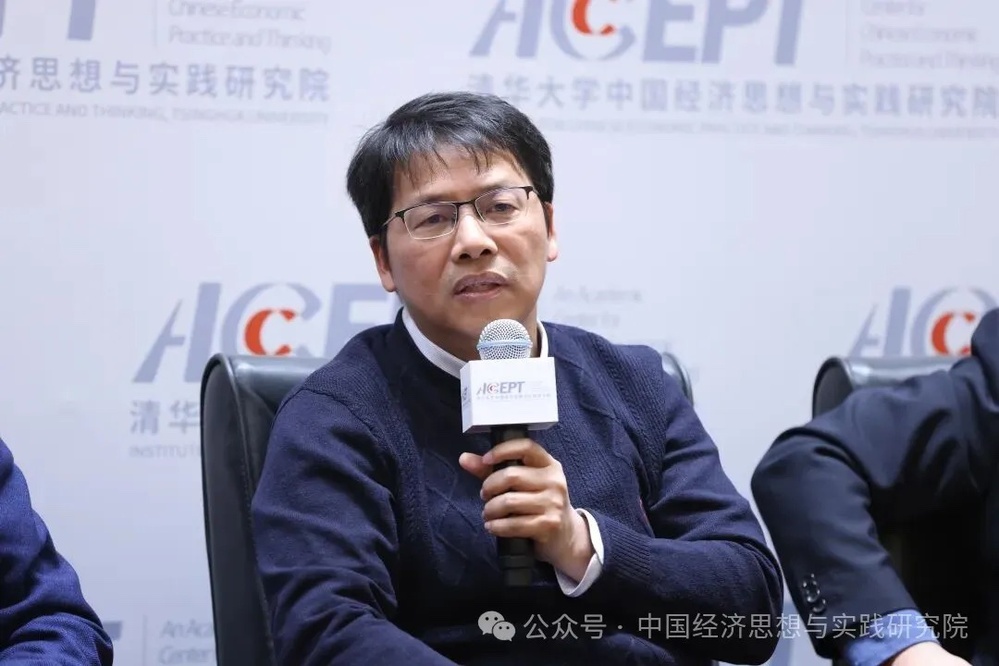
Lin Zhouchen argued that China will become the winner in the Sino-American competition over AI: first, China’s national system possesses institutional advantages; second, China has advantages in skilled talent in terms of the number and quality of students pursuing higher education; third, China has a significant leading edge in data at the level of actual applications of AI; and fourth, China has superiorities given its well-developed industrial and power infrastructure as well as its complete industrial chain. At present, when it comes to China’s gaps in cutting-edge technological processes, the country has the ability to quickly catch up given that the iteration speed for such advanced processes slows down as the degree of difficulty involved increases.
He highlighted that the current private enterprise-oriented model of the US has encountered certain stumbling blocks, with the returns from expanding the scale of computing power having declined significantly and with almost all AI companies in the US now losing money, a trend that will soon be unsustainable. Alternatively, China has advocated for employing AI as a way to augment various targeted use case scenarios in order to improve efficiencies, while investing in the deployment of AI only after the potential for profitability has been established, which is a comparatively more pragmatic approach. Current AI technologies are highly capable at processing data and information, but deficiencies remain as concerns interactions with the physical world. As a result, industries dominated by information processing are better positioned to integrate AI, with those industries requiring more real-world physical interaction meanwhile being relatively slower to integrate AI, although the potential for further adoption in the latter remains massive. He further specified that it remains difficult to produce efficiencies given the current scattered layout of computing infrastructure, which therefore demonstrates the need to establish unified national computing power facilities. By providing computing power vouchers to meet the demand for computing power, this will in turn give full play to the advantages derived from achieving economies of scale.
Lin also commented that although the current level of AI is still far from reaching the level of artificial general intelligence, the technology has already reached a medium to high level in some industries in terms of its capabilities, which has already had a considerable impact on some areas of employment. Thus, students nowadays should recognize the fact that many industries may possibly be disrupted in the future, which means that continuous learning will become a necessity. For most people, moreover, mastering AI will become an indispensable basic skill in the future.