


Qin Hong: Real estate market has entered a full-dimensional and all-inclusive stage
The following is a summary of Qin Hong's remarks at the 50th Tsinghua University Forum on China and the World Economy held at Tsinghua University, Beijing, and broadcasted online on January 13, 2026. Qin is a Senior Researcher of Renmin University of China's National Academy of Development and Strategy and former Director of the Policy Research Center at the Ministry of Construction (Ministry of Housing and Urban-Rural Development from 2008).
On January 13, 2026, the 50th Tsinghua University Forum of China and the World Economy, hosted by Tsinghua University's Academic Center for Chinese Economic Practice and Thinking (ACCEPT) in partnership with the university's School of Social Sciences, was broadcasted online under the theme of "China's Economy in 2026." Senior Researcher of Renmin University of China's National Academy of Development and Strategy and former Director of the Policy Research Center at the Ministry of Construction (Ministry of Housing and Urban-Rural Development from 2008), Qin Hong, delivered remarks and participated in roundtable discussions at the forum alongside other distinguished guests where he commented on the state of the Chinese economy.
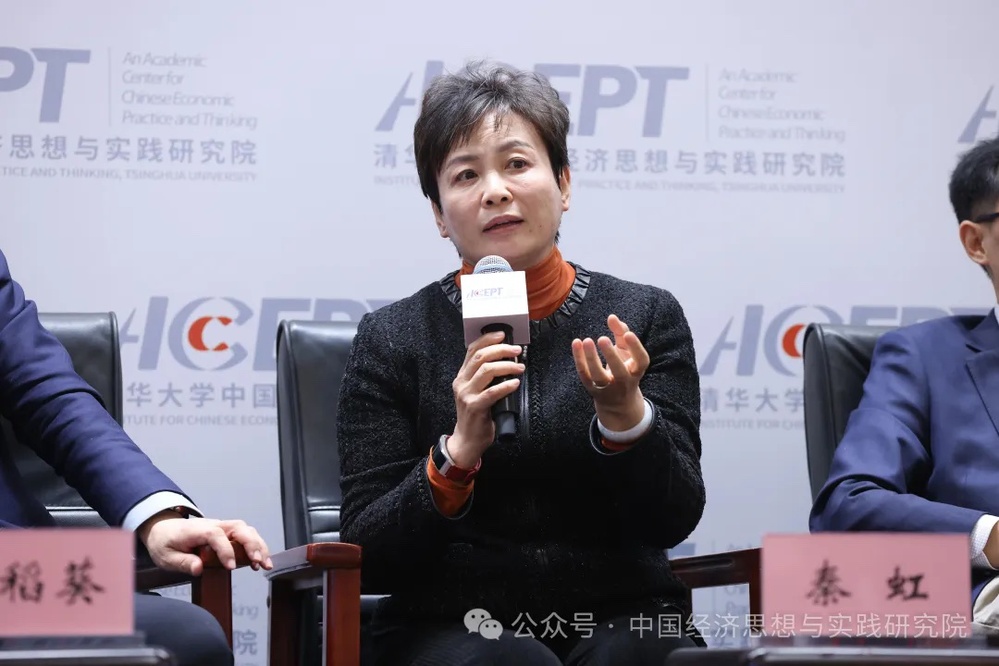
Qin Hong relayed her view that, at least from a country-wide perspective, it remains difficult to foresee a significant turnaround in the real estate market. By the end of 2025, the total area of new commodity residential properties sold for the year had a negative growth rate of around 8%, while the overall volume of sales showed a negative growth rate of 10%. In order to achieve positive growth momentum in 2026, there needs to be a rebound in sales by an order of 10% or higher, which therefore presents a significant hurdle. The second-hand housing market is also facing pressures from a high number of listings and an overall state of oversupply, with little optimism at present in the prospects for a U-turn. In 2025, national real estate indicators were all generally in the negative, with the only positive growth accruing to the saleable area of commodity housing inventories sold on consignment. Although the overall market is sluggish, there are still some bright spots that are constructive signs: according to data from the China Index Academy, the new home price index in 100 cities across the country increased slightly on a month-over-month and year-over-year basis in December, mainly arising from strong sales for a small number of high-end housing projects. These projects have driven prices up to a certain degree, but the transaction volume has been small and is not representative of the overall situation, being more about meeting the asset allocation needs of high-net-worth individuals rather than indicating an improvement in rigid demand.
She underscored that the differentiation of residential properties in the real estate market has entered a stage where it is now full-dimensional and all-inclusive. Higher-quality housing units in key cities and key districts have taken the lead in terms of their market performance, but there is no historical comparison to draw upon and this moreover does not represent the overall trend. Meanwhile, cities that did not experience the most recent surges in prices have witnessed only minor declines, with housing prices even remaining stable. Local governments are actively expanding the construction of high-end housing projects and selling land to stabilize their finances, but there is a direct conflict between the goal of increasing incremental supply on the one hand and the goal of balancing supply and demand while stabilizing prices on the other hand.