


Zhang Bin: Turnaround in asset prices imminent as upbeat performance expected for real estate market in 2026
The following is a summary of Zhang Bin's remarks at the 50th Tsinghua University Forum on China and the World Economy held at Tsinghua University, Beijing, and broadcasted online on January 13, 2026. Zhang is Deputy Director of the Institute of World Economics and Politics (IWEP) at the Chinese Academy of Social Sciences (CASS).
On January 13, 2026, the 50th Tsinghua University Forum of China and the World Economy, hosted by Tsinghua University's Academic Center for Chinese Economic Practice and Thinking (ACCEPT) in partnership with the university's School of Social Sciences, was broadcasted online under the theme of "China's Economy in 2026." Deputy Director of the Institute of World Economics and Politics (IWEP) at the Chinese Academy of Social Sciences (CASS), Zhang Bin, delivered remarks and participated in roundtable discussions at the forum alongside other distinguished guests where he commented on the state of the Chinese economy.
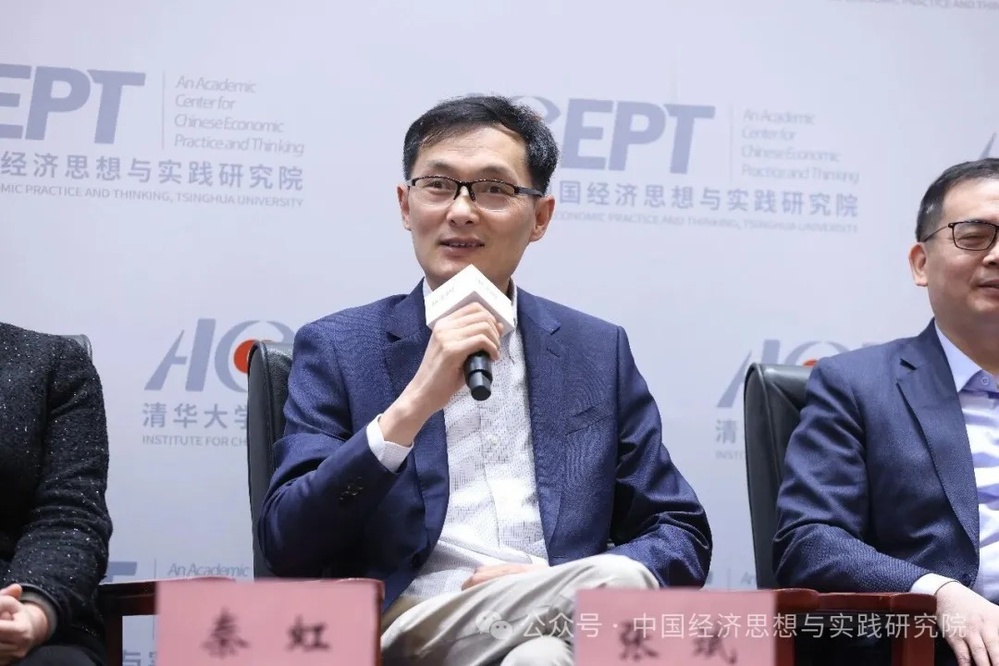
Zhang Bin explained that in the context of the continuously ratcheting up counter-cyclical policies, economic sentiment in 2026 is expected to be significantly better than that in 2025, which means that one can remain optimistic about future macroeconomic trends. In response to the widely acknowledged news about China’s trade surplus, he mentioned that the deep logic behind this phenomenon not only stems from improvements to China's manufacturing competitiveness and import substitution effects, but also reflects the cyclical challenges associated with insufficient domestic demand and the resulting undervaluation of the Renminbi’s (RMB) real effective exchange rate. In order to resolve the contradiction of “strong supply and weak demand,” Zhang stressed that the most important way to expand domestic demand depends on energizing market forces, rather than relying solely on government-backed investments. He recommended a significant reduction in real interest rates as one of the main measures to undertake, which would effectively reduce the costs associated with private enterprises’ investments and residents' home purchases, thereby improving expectations of higher gains and enabling the “accounts” of individual decision-making units within the economy to be more readily managed. Zhang further advised that if the central bank’s policy interest rate can drive the broad-spectrum of borrowing and savings interest rates across the country to continue falling, and if kept within the bounds of a firm commitment to the inflation target, such moves will help to effectively stabilize public sentiments and invigorate the potential for domestic consumption. According to these views, he therefore predicted that a reversal in the downward trend for asset prices has begun to take hold, with the improving performance of the real estate market thus being a point of great anticipation in 2026.